
SECURITY DOESN’T ONLY FAIL AT THE LOCKIt can also fail when the environment unnecessarily reveals where access exists or how it operates.Disguised Security Technology™ (DST™) is a governance-led security framework focused on reducing behavioural exposure risk by concealing, disguising or reducing visible signals that indicate access points, assets, vulnerabilities or operational routines.
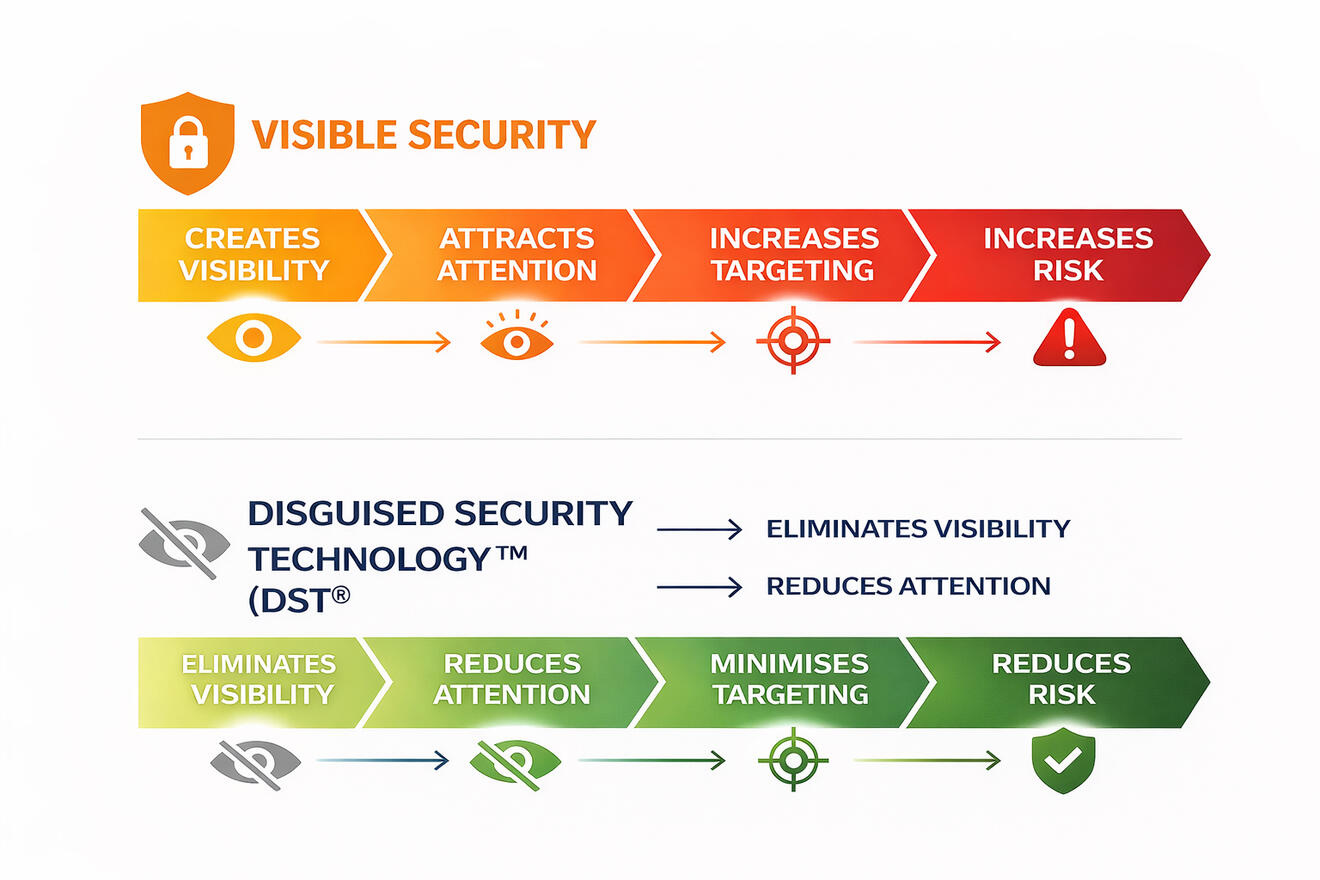
DST™ IS NOT SURVEILLANCE OR MONITORING TECHNOLOGYWithin its current application focus, Disguised Security Technology™ applies concealment-led physical security principles to access protection.It is concerned with reducing unnecessary visible and inferable security signals—not observing people, recording activity, tracking individuals or collecting personal data.⸻THE SHIFTSecurity is not only about the physical strength of a control.It is also about what the surrounding environment may communicate about access.Disguised Security Technology™ introduces an additional security layer focused on reducing:* unnecessary visible access exposure
* predictable access signals
* identifiable targeting cues
* information available through casual observationDST™ does not replace established locks, access controls or visible deterrence.It complements them by asking:Does this environment unnecessarily advertise where access exists or how it operates?Where visibility may create avoidable exposure, DST™ supports proportionate concealment, discreet environmental integration and responsible access governance.
DST eliminates the starting point of attack.
A new approach to target hardening.
Disguised Security Technology™Disguised Security Technology™ (DST™) is a governance-led security framework focused on reducing behavioural exposure risk by concealing, disguising or reducing visible signals that indicate access points, assets, vulnerabilities or operational routines.Developed and stewarded by KeySpot Security Ltd in the United Kingdom, DST™ explores how proportionate concealment, environmental integration and responsible access governance can reduce unnecessary visible and inferable security signals.The current application focus of DST™ is concealment-led physical security within buildings, properties and operational environments.DST™ is intended to support established physical protection and authorised access arrangements—not replace them.This website serves as the official public reference point for the DST™ framework, terminology, principles and developing governance model. The controlled DST™ Official Doctrine remains the canonical source for its definition, hierarchy and boundaries.DST™ was originated by Mark Cowie, founder and director of KeySpot Security Ltd.⸻The ShiftSecurity is not only about the physical strength of a control.It is also about what the environment may communicate about:* where access exists
* where credentials may be stored
* how authorised access operates
* which locations may attract unnecessary attentionDST™ introduces an additional security layer focused on reducing unnecessary visibility, behavioural exposure and predictable access signals.Security should not unnecessarily advertise access.⸻📩 [email protected]
🌐 www.keyspotkeysafe.co.uk
This site serves as the official global category definition for Disguised Security Technology™ (DST®), a UK-originated physical security classification.KeySpot® is the first real-world implementation of the Disguised Security Technology™ (DST®) classification.
DST Certified® FrameworkDST Certified® is a registered trade mark of KeySpot Security Ltd and the name of a future conformity, assessment and authorised-use framework currently under development.The framework is intended to establish a controlled pathway for assessing whether products, installations, processes and professional practices align with the approved principles, evidence requirements and governance criteria of Disguised Security Technology™ (DST™).Its developing structure may include:* eligibility and assessment criteria
* evidence requirements
* controlled use of the DST Certified® designation
* licensing and authorised-use conditions
* review, renewal, suspension and withdrawal procedures
* governance controls designed to protect the integrity of DST™DST Certified® is not currently an active public certification scheme, independent accreditation, British Standard, police approval, government approval or insurance approval.No product, installer, organisation or service may currently be described as DST Certified® unless the formal governance framework has been activated and a specific conformity decision has been formally recorded by KeySpot Security Ltd.
👉 Download Certification Framework
DST™ Foundational Framework
Defines the category, principles, and structure of Disguised Security Technology™👉 Download Framework
Why Visible Access Can Create RiskSecurity weaknesses do not arise only from the physical strength of a lock or access-control device.Risk may also increase where an access arrangement becomes visible, predictable or easily inferable.Depending on the environment, visible access arrangements may create:* identifiable points of interest;
* predictable access locations;
* increased opportunity for observation;
* unnecessary information about authorised access;
* potential opportunities for tampering or misuse.When an access arrangement is easy to identify, it may become easier to observe, infer or target.DST™ introduces an additional security question:Does the environment unnecessarily advertise where access exists or how it operates?DST™ does not replace strong locks, established access controls or appropriate physical protection. It complements them by reducing unnecessary visible and behavioural exposure where proportionate, lawful and operationally appropriate.⸻DST™ Core PrinciplesDisguised Security Technology™ is supported by the following principles:* reduce unnecessary visible access signalling;
* reduce inferability and predictable targeting cues;
* preserve practical authorised access;
* support responsible environmental integration;
* consider operational friction and access delays;
* support safeguarding, accountability and access governance;
* operate alongside established physical and digital security systems;
* recognise and manage behavioural exposure;
* identify and communicate residual risk.Concealment alone does not establish a DST™ implementation.Responsible application also depends on appropriate design, evidence, operating procedures, safety considerations and site-specific risk management.⸻Academic Engagement and Innovation SupportKeySpot® has received innovation and enterprise support through the University of Sunderland’s Arrow Innovation Support Programme.This support has contributed to the structured development and review of KeySpot® and has helped inform the continuing refinement of the associated Disguised Security Technology™ framework.The University relationship has provided a formal innovation-support environment in which product development, operational considerations and potential future research opportunities have been explored.This involvement does not constitute:* University approval or endorsement;
* independent product validation;
* certification or accreditation;
* police or insurance approval;
* confirmation of security performance.Named quotations, findings, logos or institutional statements will only be published where the relevant written permissions have been confirmed.⸻Why This Engagement MattersThe innovation and research activity surrounding KeySpot® has helped explore whether DST™ may provide a useful framework for considering:* visible and inferable access exposure;
* discreet managed-access arrangements;
* environmental integration;
* authorised-user experience;
* operational access procedures;
* behavioural and residual risk;
* future evidence and assessment requirements.This activity contributes to the continued development of DST™ as a UK-originated, evidence-led security framework.It does not establish DST™ as an independently validated framework, formal industry standard or active certification scheme.⸻Official Reference PositionThis website serves as the official public reference point for the purpose, terminology and developing governance of Disguised Security Technology™.The controlled DST™ Official Doctrine remains the canonical source for the definition, hierarchy, principles and boundaries of the framework.
Evidence & Real-World Insight
The Problem With Visible Key SafesTraditional key safes provide practical authorised access. However, where they are clearly visible, predictably located or poorly managed, they may create unnecessary access-related exposure.Visibility, user behaviour, installation quality and credential-management practices can all influence risk across residential, care, commercial and managed-property environments.This is one of the gaps that Disguised Security Technology™ (DST™) is designed to address:Reducing unnecessary visible and behavioural access exposure while preserving safe, practical and authorised access.
A Recurring Security Consideration Across SectorsAcross different sectors and operational environments, a recurring security consideration may arise:Security weaknesses are not always caused by weak locks, inadequate hardware or an absence of established security controls.Risk may also increase when access arrangements are:* identifiable;
* predictable;
* observable;
* easily inferable.Where access points, credentials or authorised-user routines are easy to recognise, they may reveal unnecessary information about where access exists or how it operates.Disguised Security Technology™ (DST™) has been developed in response to this wider security consideration.DST™ focuses on reducing unnecessary visible and inferable access exposure while preserving safe, practical and authorised access.Access security should consider not only the strength of the control, but also what the surrounding environment communicates before attention is directed towards it.
Disguised Security Technology (DST)
Official Definition & Category Framework
Traditional Security ThinkingVisible → Predictable → TargetableDisguised Security Technology™Concealed → Less Identifiable → Lower Exposure
Disguised Security Technology™ (DST) Official Definition & Standard (PDF) v 1.2
Disguised Security Technology™Security should not unnecessarily advertise accessDisguised Security Technology™ (DST™) is a governance-led security framework focused on reducing behavioural exposure risk by concealing, disguising or reducing visible signals that indicate access points, assets, vulnerabilities or operational routines.Developed and stewarded by KeySpot Security Ltd, DST™ provides a structured approach to identifying and reducing unnecessary visible and inferable security signals within buildings, properties and operational environments.DST™ considers not only the strength of a security control, but also what its visibility, location, surrounding environment and patterns of use may communicate.KeySpot® is the first operational implementation of DST™.⸻Why DST™ ExistsTraditional security often concentrates on strengthening a visible access point.However, a visible or easily inferable access arrangement may still communicate useful information about:* where access may be available
* where keys, codes or credentials may be used
* which locations deserve closer observation
* how authorised users interact with a system
* where attention may be focusedPhysical strength remains essential.DST™ introduces an additional question:Does the environment unnecessarily advertise where access exists or how it operates?DST™ is intended to reduce avoidable environmental signalling while preserving safe, practical and authorised access.It does not eliminate all risk and must operate alongside appropriate physical protection, access governance, user procedures and site-specific risk management.⸻Core PrincipleSecurity should not unnecessarily advertise accessDST™ may support security environments through:* reducing unnecessary visible access signals
* reducing information available through casual observation
* making access arrangements less immediately identifiable
* supporting discreet environmental integration
* preserving practical authorised access
* recognising and managing residual riskThe objective is not absolute invisibility.The objective is to reduce unnecessary exposure without weakening safety, accountability, usability or authorised access.⸻How DST™ WorksDST™ considers security across four connected areas.Environmental SignallingWhat does the environment visibly or indirectly communicate about the presence, location or purpose of an access point, asset or security arrangement?Behavioural ExposureCould repeated movements, routines, code entry or patterns of use reveal how an access arrangement operates?Managed AccessCan authorised users obtain appropriate access through clear, controlled and proportionate procedures?Residual RiskWhat risks remain after concealment or signalling reduction has been applied?DST™ does not treat concealment as a complete security solution.It combines concealment-led implementation with appropriate physical protection, access responsibility, user guidance and ongoing risk management.⸻Security ArchitectureTraditional Security Arrangement* visible access point
* visible security hardware
* physical or digital access control
* key, code or credential-based access
* observable user interactionDST™-Integrated Arrangement* concealment-led physical integration
* reduced visible and inferable access signals
* proportionate physical protection
* controlled authorised access
* digital identity or access systems where appropriate
* clear operational and governance proceduresDST™ complements established security controls. It does not replace them.⸻Connected Security LayersPhysical and Environmental ImplementationDST™ principles may be applied through:* proportionate concealment
* environmental integration
* signalling reduction
* reduced access-point discoverability
* discreet physical implementation
* appropriate target hardening**Digital and Administrative SystemsSeparate systems may support:* identity verification
* user permissions
* credential management
* access revocation
* event logging
* monitoring or control where lawfully and appropriately requiredDST™ itself is not a surveillance or monitoring category.Physical, digital and administrative systems may complement one another, but they should not be treated as interchangeable.⸻Current Application FocusThe current application focus of DST™ includes:* fixed and property-integrated security arrangements
* structural and access-based protection mechanisms
* concealment-led managed-access solutions
* non-surveillance physical security systems
* security-relevant infrastructure within buildings
* operational access arrangements where visible signalling may create unnecessary exposurePotential environments may include:* residential properties
* social and multi-family housing
* vacant and managed properties
* commercial buildings
* facilities-management environments
* care and supported-living environments
* estate-management operations
* short-term accommodation
* authorised contractor access
* emergency and contingency access arrangementsInclusion within this list does not automatically establish suitability.Every implementation must be assessed according to its environment, purpose, users, safety responsibilities and residual risks.⸻Explicit BoundariesDST™ does not include:* surveillance systems
* covert recording systems
* audio or visual monitoring technologies
* tracking technologies
* body-worn devices
* personal monitoring products
* consumer surveillance technologies
* data-collection systems merely because they are concealed
* concealment intended to facilitate unlawful access, deception or harmDST™ is concerned with the responsible reduction of unnecessary security-relevant signalling.It must not be used to disguise unsafe, unlawful or improperly controlled access arrangements.⸻Safety and Responsible UseDST™ is designed to operate alongside applicable:* building and property requirements
* fire-safety arrangements
* safeguarding responsibilities
* emergency-access procedures
* access-control policies
* insurance-aware risk considerations
* health and safety requirements
* site-specific operating proceduresDST™ does not override legal, contractual, regulatory, insurance or emergency-access obligations.Each implementation must operate alongside relevant legal, safety, technical and access-control requirements.Specialist legal, insurance, safety or technical advice should be obtained where appropriate.⸻KeySpot®The First Operational Implementation of DST™KeySpot® is being developed as a discreet managed-access solution designed to support authorised access without unnecessarily advertising the location or purpose of the access point.It applies DST™ principles through:* concealment-led physical integration
* reduced visible access signalling
* practical authorised access
* controlled operating procedures
* consideration of user behaviour
* recognition of residual riskKeySpot® is undergoing controlled operational research and commercial development as the first operational implementation of DST™.KeySpot® should not currently be described as:* police approved
* insurance approved
* independently certified
* proven to prevent crime
* risk-free
* impossible to identify
* impossible to attackResearch, operational evaluation and commercial development do not automatically constitute endorsement, certification or independent validation.⸻Research and EvidenceKeySpot® and DST™ are being developed through controlled research, operational observation and evidence-led framework refinement.Research activity may consider:* environmental integration
* visible and inferable access signals
* authorised-user experience
* key and credential-management arrangements
* operational friction
* user behaviour
* access and code lifecycle
* insider and owner responsibilities
* residual risk
* governance requirementsResearch findings should only be published where:* the evidence has been accurately recorded
* relevant reviewers have confirmed accuracy
* appropriate external-use permission has been obtained
* limitations and residual risks are clearly stated
* wording has passed the DST™ claims-control process
* named sites, people and organisations have been treated appropriatelyResearch activity does not automatically constitute:* independent validation
* certification
* endorsement
* approval
* proof of crime prevention⸻Academic EngagementKeySpot® has received innovation and enterprise support through the University of Sunderland’s Arrow Innovation Support Programme.This support has contributed to the structured development and review of KeySpot® and has informed refinement of the associated DST™ framework within a formal innovation-support environment.This involvement does not constitute:* University approval
* University endorsement
* University certification
* independent validation
* proof of product performanceNamed findings, quotations, photographs or institutional references will only be published where the relevant permissions have been confirmed.⸻Developing Assessment ApproachesDST™ is supported by developing assessment approaches intended to structure evidence and improve security decision-making.PARP™ — Premises Access Risk ProfilePARP™ is a developing approach for reviewing wider premises-level operational and behavioural exposure associated with access arrangements.It may consider:* visibility
* inferability
* discoverability
* observation opportunity
* behavioural leakage
* concealment integration
* access governance
* operational exposure
* residual riskRSI™ — Risk Signal Index™RSI™ is a developing signal-level approach for reviewing how visible, discoverable or inferable a security-relevant access point appears within its environment.RSI™ primarily focuses on static environmental signalling.It does not, by itself, measure every aspect of:* active-use behaviour
* user governance
* insider risk
* credential management
* access revocation
* operational access controlPARP™ and RSI™ are controlled developing assessment approaches.They are not currently:* independent certifications
* British Standards
* police approvals
* insurance approvals
* universal guarantees of security performance⸻Future Conformity FrameworkDST Certified®DST Certified® is a registered trade mark of KeySpot Security Ltd and is the name of a future conformity and trust framework currently under development.It is intended to provide a controlled route for assessing whether products, processes, installations or professional practices align with formally approved DST™ principles, evidence requirements and governance criteria.The future framework may support:* product assessment
* implementation assessment
* installation principles
* professional competence requirements
* controlled designation use
* review and renewal procedures
* withdrawal or suspension procedures
* licensing and authorised-use controlsRegistration of the DST Certified® trade mark does not mean that an active certification or accreditation scheme currently exists.DST Certified® is not currently:* an active public certification scheme
* an independent third-party accreditation
* a British Standard
* a police or government approval
* an insurance approval
* a public product endorsement
* a guarantee of security performanceNo product, installer, organisation, assessor, service or process may currently be described as DST Certified®.The designation may only be used after:* the formal governance framework has been approved
* applicable assessment criteria have been controlled
* appropriate evidence has been reviewed
* a specific conformity decision has been formally recorded
* authorised use has been issued by KeySpot Security LtdDST Certified® must not currently be displayed as a live approval or certification badge.⸻Governance and Category ControlDisguised Security Technology™ is developed and stewarded by KeySpot Security Ltd.Its controlled framework includes:* a canonical definition
* approved terminology
* category boundaries
* evidence requirements
* claims controls
* assessment approaches
* document control
* future conformity governanceThese controls are intended to:* protect the meaning of DST™
* prevent category drift
* reduce unsupported claims
* maintain consistent public language
* preserve evidence integrity
* support responsible institutional use
* protect the long-term authority of the frameworkA concealed product, installation or system does not automatically qualify as a DST™ implementation.Qualification depends on governed application, appropriate evidence, responsible design, safety considerations and residual-risk management.This website is the official public publication portal for DST™.The controlled DST™ Official Doctrine remains the canonical source for the definition, hierarchy and boundaries of the framework.⸻OriginDisguised Security Technology™ originated in the United Kingdom.DST™ establishes an emerging approach to security that considers not only the strength of a security control, but also the information communicated by:* visibility
* location
* environmental context
* operational routines
* authorised-user behaviourDST™ supports the development of arrangements intended to:* reduce unnecessary visual targeting cues
* reduce identifiable access signals
* integrate discreetly into everyday environments
* preserve safe and authorised access
* recognise behavioural and operational exposure
* identify and manage residual riskDST™ does not claim that concealment alone provides complete protection.⸻Institutional and Research EngagementKeySpot Security Ltd welcomes controlled discussions with:* universities
* councils
* housing providers
* facilities-management organisations
* care and supported-living providers
* security professionals
* manufacturers
* testing organisations
* standards bodies
* insurers and risk professionals
* research partnersEngagement may include:* controlled research trials
* framework review
* operational observation
* assessment-method development
* evidence generation
* product evaluation
* institutional adoption pathwaysAll activity is subject to appropriate confidentiality, publication permissions, evidence requirements and claims controls.⸻Current StatusDST™ is an emerging proprietary security framework developed and stewarded by KeySpot Security Ltd.It is not currently:* a British Standard
* an independent certification scheme
* a government approval
* a police approval
* an insurance approval
* a guarantee of crime prevention
* a replacement for established physical-security requirements
* a replacement for legal, safety or access-control responsibilities⸻Official ContactKeySpot Security Ltd📧 [email protected]
🌐 www.keyspotkeysafe.co.uk⸻Footer© 2026 KeySpot Security Ltd. All rights reserved.Disguised Security Technology™, DST™, PARP™, RSI™ and related controlled terminology are proprietary names, marks and framework assets developed and stewarded by KeySpot Security Ltd.KeySpot® and DST Certified® are registered trade marks of KeySpot Security Ltd.Registration of DST Certified® does not imply that an active certification or independent accreditation scheme currently exists.Use of DST™ terminology does not imply external accreditation, endorsement, approval or certification.

Archive
Disguised Security Technology™ (DST™)Disguised Security Technology™ (DST™) is a governance-led security framework focused on reducing behavioural exposure risk by concealing, disguising or reducing visible signals that indicate access points, assets, vulnerabilities or operational routines.DST™ was developed and is stewarded by KeySpot Security Ltd in the United Kingdom.The framework introduces an additional security consideration by examining not only the physical strength of a security control, but also what its visibility, location, surrounding environment and patterns of use may communicate.The current application focus of DST™ is concealment-led physical security and managed-access arrangements within buildings, properties and operational environments.DST™ does not treat concealment as merely an accessory added to an existing product. It provides a structured framework for considering:* responsible design;
* environmental integration;
* safe and practical authorised access;
* evidence requirements;
* operational governance;
* behavioural and residual-risk management.These principles may support the responsible development of future products, installations, processes and use cases.⸻DST Certified®DST Certified® is a registered trade mark of KeySpot Security Ltd and the name of a future conformity-assessment and authorised-use framework currently under development.It is intended to provide a controlled pathway for assessing whether products, installations, processes or professional practices align with the controlled principles, evidence requirements and governance criteria of DST™.Registration of the DST Certified® trade mark does not mean that an active certification, accreditation or public conformity-assessment scheme currently exists.No product, installer, organisation, process or service may currently be described as DST Certified® unless the formal framework has been activated and KeySpot Security Ltd has issued a documented conformity decision under that framework.DST™ is an emerging governance-led security framework. It is not currently:* a British Standard;
* government or police approval;
* insurance approval;
* independent accreditation;
* an independently recognised industry standard;
* a guarantee of security performance.
RECOGNISED & SUPPORTED
University of Sunderland – Innovation Partner
Supporting KeySpot® and Disguised Security Technology™ (DST®)
University-backed KeySpot® case study
Early research and application of Disguised Security Technology™ (DST™) is documented in a university case study featuring KeySpot®.
Hope Street Xchange – Innovation feature highlighting DST category development